Home Blog Page 23

Leaders, Kenyans in solidarity with Tuju

0

By Anderson Ojwang

Kenyans from all walks of life and political leaders were in solidarity with former Cabinet Minister Raphael Tuju after police locked him out of his disputed business premises.

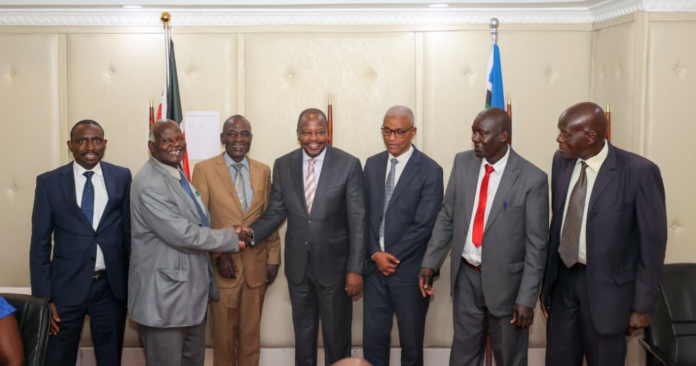
ODM National Chairperson Gladys Wanga, Vice National Chairman Dr Otiende Amolo, Embakasi East MP Babu Owino and businessman Jimmy Wanjigi were among the leaders who visited the premises to stand with Tuju in solidarity.

Wanga was captured making frantic telephone calls in a bid to break the stalemate while Otiende called for the removal of the police officers from the facility.

“It is legally wrong to block Tuju from accessing his premises when you do not have court papers that guarantee you such liberty. Get the court documents first and before that Tuju should be allowed to access his facility,” he said.

Homa Bay MP George Opondo Kaluma wrote on his X handle, “This is the only property/hotel business owned by a Luo in Nairobi.
We will defend it to the last drop of our blood, to our last generation.
Whoever thinks he can take this property should prepare to kill all Luos before that—let no one try eviction there again.”

Tuju on Saturday, in a meeting with his family and relatives, showed them his burial place should he be killed over the bid to take over his multi-billion premises in Nairobi’s upmarket Karen.

Tuju told the family the specific place he would wish to be buried should he be killed over his move to protect his property.

“Today, I told and showed my family and relatives the specific place I would wish to be buried. I am not ready to be killed over my property.
I will not sit and watch my property taken away.
Let them kill me first. I will be happy that I was killed protecting the family property and my grandchildren will know where and how their grandfather died,”
he said.

On Saturday at dawn, over 100 police officers stormed Tuju’s premises in what Tuju termed as continuous intimidation.

He said the police officers, some with unmarked police vehicles, stormed the facility and denied everyone entry to the facility.

“I do not know why the police have decided to occupy my facility. They do not even have court orders. I will not be cowed,” he said.

Tuju has declared that only over his dead body will he lose his property after an auctioneer went to claim the facility.

He said the agents of a gentleman by the name Chebet brought a fellow called Mr. Kiprop to take over the property.

“They had no court order and court papers. They just think they can come and intimidate me so that they can come and take over my property.
It is very simple what they have to do. They have to shoot me to get a big burial for me in Rarieda Constituency. I am sure my constituents will come to mourn. After I have been put into the grave, then they can come and take the property through such kind of impunity.
I am not going to take this kind of intimidation. It is very simple. They kill me first. I am not taking that kind of intimidation,”
he said.

Tuju has been overwhelmed with support and goodwill from Kenyans and the international community over the attempted takeover of his premises by an auctioneer over a long-running commercial debt court battle.

“I am overwhelmed by the messages of support and goodwill from friends, relatives and many Kenyans, not to mention members of the international community. I am indeed humbled and grateful for your prayers and words of encouragement,” he said.

Similarly, the High Court also granted Tuju the authority to appeal the Monday ruling by Judge Josephine Mongare that the matter was already settled, opening the door for recovery of the prime assets tied to a long-running debt.

After the ruling by Justice Mongare on Monday, she denied him the constitutional right of appeal and stated on record that it would be subject to her discretion.

“I have a right to appeal but the judge didn’t give me that opportunity. The 2010 Constitution gives me the right to appeal. You know there are corruption cases on this matter. People were arrested at my place because they were insisting that I must give them money to allegedly allow any appeal and any stay of execution and any status quo. I have already made an application,” he said.

Tuju said goodwill messages and support from Kenyans and the international community were a sign of love and respect from the public.

He said on Monday four people, including a former High Court judge, came to his premises to collect a bribe and were arrested by the Ethics and Anti-Corruption Commission (EACC).

Former High Court Judge Joseph Mutava and three other suspects were released on Sh200,000 cash bail each pending investigations into bribery claims.

The four, who also included a lawyer, spent Monday night in cells following their arrest by Ethics and Anti-Corruption Commission (EACC) officials.

Officials said they will forward the outcome of the investigation to the Office of the Director of Public Prosecutions (ODPP) for review and possible charges.

“These individuals had been in touch with me for several weeks. There are details of my encounter that I may not dwell on before the investigations are completed,” he said.

He said currently he was politically exposed and he has to fight to protect his property.

“Given the fact that I am a politically exposed person, I cannot be so naive as to think that this conflict with the bank would engage my political enemies who are many all over the country,” he said.

Tuju said the move was aimed at intimidating and blackmailing him into submission after some suspects were arrested at his premises for allegedly soliciting a Sh10.4M bribe over a case in court.

He wondered why the agent had to invade his premises with goons instead of using proper legal channels.

“On Wednesday evening the firm of Lavington Security, led by Mr. Kiprop, under the instructions of Mr. Jackson Chebet and their lawyer Mr. Kiprono, accompanied by over a hundred goons stormed our Dari Business Park, which now hosts Tamarind Restaurant, in an attempt to throw me out.

If they had valid eviction orders, they needed not come with goons. Fortunately, after the commotion they created, my people informed the Karen Police Station, who came to restore order,” he said.

Tuju said the power of prayer and God’s intervention has seen him through turbulent moments but expressed optimism of victory.

“God continues to see me and my family through this difficult journey,” he said.

Government to standardize fares for digital taxi operators

0

By Phillip Orwa

The Kenyan government is moving to standardize fares for digital taxi operators that include Little Cab, Yego, Weego, Faras, Uber and Bolt by implementing a new national pricing model to address low driver earnings and disputes over fair compensation.

Last year, drivers through the Amalgamation of Online Drivers brought together drivers who ply the online trade, including the Organisation of Online Drivers (OOD) and the United Organisation of Drivers (UOD), in a strike to help force the applications to increase the prices.

Late last year, digital taxi drivers in Kenya met with Ministry of Transport (Kenya) officials and National Transport and Safety Authority (NTSA) representatives to seek a hearing over a strike they had conducted over low earnings, high commissions, and rising operational costs.

The strike, often referred to as a “digital blackout,” involved drivers shutting off apps from services like Uber, Bolt and Faras.

During the discussions then, representatives of the digital taxi drivers and ministry officials resolved that the applications should be guided by the AA rates, but to date the rates are yet to be implemented.

Justin Nyaga, the Chairman of the Organisation of Online Drivers, welcomed the government’s new move and said that they are still awaiting the apps’ response after they were ordered by the government to implement the AA rates, which they are yet to implement to date.

We held several meetings and expected that the apps would adhere to the government order that they implement the AA Rates,” said Nyaga in one of the meetings with the members.

Brian Munyendo, one of the drivers operating under the OOD fraternity, then said “Drivers operating the digital apps were just demanding standard rates where payments do not drop below a specific minimum price, the current rates are uneconomical and do not cover fuel, maintenance, and app fees.”

And after a long struggle from the digital drivers, the Ministry of Transport is now reportedly set to develop a mandatory taxi pricing policy to address the complaints of predatory fares.

Meetings have included representatives from companies like Uber, Bolt and Little Cab, with discussions aimed at revising the current commission structures.

The Ministry of Transport, driven by complaints of unfair labour practices and protests from driver associations, is currently setting a minimum fare structure.

The government has mandated the adoption of rates approved by the Automobile Association of Kenya (AAK), which include a base rate of KSh 33 per kilometre.

Total cost per kilometre is expected to be approximately Sh39, accounting for platform commission and a per-minute driver salary component, particularly for vehicles with engine capacities not exceeding 1,000cc.

Drivers have been pushing for a minimum fare of Sh300 to ensure profitability.

The state has previously directed that commissions paid by drivers to the platforms be capped, moving to regulate them at 18 per cent per trip, down from higher rates, to ensure drivers maintain a reasonable take-home pay.

The Transport ministry is reviewing driver and operator cost structures to ensure that pricing covers key expenses like fuel, insurance, and vehicle maintenance.

Why Victory Farms Has Embarked on Restocking the Extinct Black Tilapia in Lake Victoria

0

By Habil Onyango

Mzee Felix Ajwang’, a resident of Kosodo Beach in Suba South Sub-County, Homa Bay County, has been part of the fishing industry since childhood.
The 70-year-old retired teacher reminisces about a time when fishing in Lake Victoria was a lucrative business, yielding significant catches and profits.

In those days, his catches predominantly consisted of black tilapia (Oreochromis niloticus) and Nile perch.
However, over time, the population of the black tilapia—a fish known for its delicious taste and nutritional value—began to dwindle and eventually became extinct in the lake.

Ajwang’ has reason to be optimistic now due to a restocking initiative led by Victory Farms, a company engaged in fish caging in Lake Victoria.
For the past several years, Victory Farms has been working to reintroduce the extinct species in the Roo catchment area, where they operate a fish caging facility, as well as in other parts of Lake Victoria.

This programme involves releasing thousands of fingerlings, aiming for a significant recovery of fish populations in the lake.
According to Mike Ouya, a Senior Partnership and Development Manager at Victory Farms, they recently introduced 200,000 fingerlings of the black tilapia species at Kosodo Beach.

He noted that this initiative marks the third community conservation area established in collaboration with the Beach Management Unit (BMU).

“We are pleased to announce the launch of our third community conservation area in partnership with the Kosodo BMU,” Ouya said.
“Victory Farms has a responsibility to protect the environment where we work in the lake, and as part of that responsibility, we have introduced
200,000 pieces of the native black tilapia species, locally referred to as ‘rech makwar,’ in collaboration with the Kosodo BMU.” he noted.

The community conservation area is designed to protect a section of the lakeshore that serves as fish breeding grounds, ensuring there is no overfishing, illegal fishing, or the use of harmful chemicals.
It also promotes the return of the species that nearly vanished by the 1960s.

Ouya revealed that the project is conducted in partnership with the Kenya Marine and Fisheries Research Institute (KMFRI), where they have successfully propagated fingerlings of the species.

“We are excited to report that, along with KMFRI, we have been able to return the black tilapia to its rightful place in Lake Victoria,” he emphasised.
“In the coming years, we hope that the species—deemed even more delicious than the tilapia commonly consumed—will provide nutrition to the community and other Kenyans.”

The extinction of this species has been attributed to competition with the introduced Nile perch, environmental degradation, Nile perch predation, and habitat loss.
Additionally, overfishing and illegal fishing practices—such as using illegal nets and targeting immature fish—have destroyed breeding habitats and exceeded the natural replenishment rates of the lake and rivers.

These activities have led to smaller fish sizes, increased mortality rates, and the potential collapse of ecosystems like Lake Victoria.

However, according to Kosodo BMU Chairman Naphatally Otieno Kibuogi, measures have been implemented to ensure the conservation area is protected.
He stated that they have agreed to provide security around the clock to prevent other fishermen from encroaching on the site.

We want to thank Victory Farms for reintroducing the tilapia species that we only heard about in our youth at Lake Victoria, especially along our beach,” he said.
“As the BMU, we have established rules and regulations to govern operations along the beach, and this area has been reserved as a breeding site for the fish, with no fishermen allowed to access it.”

Suba Central Fisheries Officer Charles Odhiambo urged the community to work together to provide security for the restricted breeding site. He noted that the species had become extinct and expressed satisfaction with the restocking initiative, hoping for breeding every three months.

“You must ensure that the region is protected day and night by providing security to deter encroachers,” he advised.

The dwindling fish population in Lake Victoria has forced many fishermen to turn to ponds and cage fishing. Odhiambo commended the initiative taken by Victory Farms to restock the lake.

Why the Project?

According to David Otieno, the Farms Community Relations Coordinator, evidence collected from the Roo Conservation area shows that the project has the potential to increase fish catches in nearly all the Beach Management Units (BMUs) they are working with, provided it is well managed.

In regions where we have initiated the programme, there have been reports of increased fish catches, indicating that the programme is effective. This is why we are encouraged and continue to invest significantly while seeking partnerships to extend it to other BMUs,” he stated.

Otieno explained that in alignment with their mission to support local livelihoods, they collaborate with BMUs to provide fingerlings to small-scale farmers in Homa Bay, aiming to enhance their production. This year, in partnership with the County Government, they have already distributed 2.5 million fingerlings at a cost of KSh 2.5 million to pond fish farmers.

Additionally, the officer mentioned that they aim to boost food security. With the decline in fish populations, the restocking programme helps replenish the lake’s resources, providing an affordable and high-quality protein source for the region’s growing population.

Furthermore, Otieno revealed that this effort is part of a broader Corporate Social Responsibility (CSR) initiative and a sustainable strategy to protect the long-term health of Lake Victoria.

Kenya and Ireland agree to negotiate a structured labour mobility framework

0

BY OPCS PRESS SERVICE

Kenya and Ireland have agreed to negotiate a structured labour mobility framework that will allow nurses and midwives to work in Ireland in the coming days, Foreign and Diaspora Affairs Cabinet Secretary Musalia Mudavadi has said.

Mudavadi said that Kenya looks forward to the conclusion of the instrument and appreciates Ireland’s commitment to the process.

“Kenya regards Ireland as a valued partner and true friend. We take pride in our diverse and multifaceted partnership, which spans a wide range of priority sectors of mutual interest, and we appreciate continued support in strengthening initiatives in food security, climate resilience, governance, and humanitarian assistance,”Mudavadi said.

He was speaking when he attended St. Patrick’s Day, the National Day of Ireland celebrations in Nairobi.

The occasion not only honours the legacy of Ireland’s patron saint but also celebrates the timeless values of faith, unity, and resilience that Saint Patrick exemplified.

Among those in attendance was Christopher O’Sullivan.

“I note with satisfaction that our relationship is marked by robust and thriving people-to-people exchanges through the activities of missionaries, initiatives by Irish non-governmental organisations, and bridge-building by the vibrant diaspora communities in both countries. For more than a century, the Irish missionaries have been part and parcel of our society, supporting the development of schools and hospitals and helping to provide essential services in remote and underserved communities,”the CS added.

On the education and innovation front, Mudavadi said Ireland’s steadfast support for the Young Scientists Kenya Programme has enriched the lives of thousands of students, nurturing creativity while opening pathways to recognition and opportunities on the global stage.

He noted that Kenya and Ireland have also worked side by side in multilateral fora, including their joint tenure on the United Nations Security Council in 2021 and 2022, where they advanced peace, human dignity, and the Sustainable Development Goals.

He assured:

“We are keen on strengthening collaboration in the multilateral sphere, especially in the context of uncertainties in the current global order. As we commemorate Ireland’s National Day, Kenya reaffirms its commitment to deepening friendship and cooperation with Ireland for the benefit of our two friendly nations and the well-being of our peoples.”

Similarly, he said that Kenya values the contributions of Irish non-governmental organisations, such as Concern Worldwide, to Kenya’s socio-economic development, particularly their work towards the improvement of livelihoods through projects in health and nutrition, education, and poverty eradication.

The CS also said that the Kenya Irish Society has played a key role in fostering ties between the peoples through cultural events, philanthropic activities, and community outreach, thus creating a forum for Kenyans and the Irish community to share traditions, celebrate diversity, and form long-lasting bonds.

Kenya and Ireland have had longstanding bilateral relations, established in 1979 and nurtured over the years through shared values, mutual respect, and a common commitment to sustainable development.

“I am grateful for the growth in our relations over the past decade, especially since the establishment of our embassy in Dublin in 2007 and the reopening of the Irish Embassy in Nairobi in 2014,”he noted.

Tuju shows family his burial site, ready to be killed over his property

0

By Team

Former cabinet Minister Raphael Tuju, in a meeting with his family and relatives, showed them his burial place should he be killed over the bid to take over his multi-billion premises in Nairobi’s upmarket Karen.

Tuju told the family the specific place he would wish to be buried should he be killed over his move to protect his property.

“Today, I told and showed my family and relatives the specific place I would wish to be buried. I am not ready to be killed over my property.

I will not sit and watch my property taken away.

Let them kill me first. I will be happy that I was killed protecting the family property and my grandchildren will know where and how their grandfather died,” he said.

On Saturday dawn, over 100 police officers stormed Tuju’s premises in what Tuju termed as continuous intimidation.

He said the police officers, some with unmarked police vehicles, stormed the facility and denied everyone entry to the facility.

I do not know why the police have decided to occupy my facility. They do not even have court orders. I will not be cowed,” he said.

Tuju has been overwhelmed with support and goodwill from Kenyans and the international community over the attempted takeover of his premises by an auctioneer over a long-running commercial debt court battle. “I am overwhelmed by the messages of support and goodwill from friends, relatives, many Kenyans, not to mention members of the international community. I am indeed humbled and grateful for your prayers and words of encouragement,” he said.

Similarly, the High Court also granted Tuju the authority to appeal the Monday ruling by Judge Josephine Mong’are that the matter was already settled, opening the door for recovery of the prime assets tied to a long-running debt.

After the ruling by Justice Mong’are on Monday, she denied him the constitutional right of appeal and stated on record that it would be subject to her discretion. “I have a right to appeal, but the judge didn’t give me that opportunity. The 2010 Constitution gives me the right to appeal. You know there are corruption cases on this matter. People were arrested at my place because they were insisting that I must give them money to allegedly allow any appeal and any stay of execution and any status quo. I have already made an application,” he said.

Tuju said goodwill messages and support across from Kenyans and the international community were a sign of love and respect from the public.

He said on Monday four people, including a former Judge of the High Court, came to his premises to collect a bribe and were arrested by the Ethics and Anti-Corruption Commission (EACC). Former High Court Judge Joseph Mutava and three other suspects were released on Sh200,000 cash bail each, pending investigation into bribery claims. The four, who also included a lawyer, spent their Monday night in cells following their arrest by the Ethics and Anti-Corruption Commission (EACC) officials. The officials said they would forward the outcome of the investigation to the Office of the Director of Public Prosecutions (ODPP) for review and possible charges.

“These individuals had been in touch with me for several weeks. There are details of my encounter that I may not dwell on before the investigations are completed,” he said.

He said currently he was politically exposed and he has to fight to protect his property. “Given the fact that I am a politically exposed person, I cannot be so naive as to think that this conflict with the bank would not engage my political enemies who are many all over the country,” he said.

Tuju has declared that only over his dead body will he lose his property after an auctioneer went to claim the facility.

He said the agents of a gentleman by the name of Chebet brought a fellow called Mr. Kiprop to take over the property.

“They had no court order and court papers. They just think they can come and intimidate me so that they can come and take over my property. It is very simple what they have to do. They have to shoot me to get a big burial for me in Rarieda constituency. I am sure my constituents will come to mourn. After I have been put into the grave, then they can come and take the property through such kind of impunity. I am not going to take this kind of intimidation. It is very simple. They kill me first. I am not taking that kind of intimidation,” he said.

Tuju said the move was aimed at intimidating and blackmailing him into submission after some suspects were arrested at his premises for allegedly soliciting Sh10.4M bribe over a case in court.

He wondered why the agent had to invade his premises with goons instead of using proper legal channels. “On Wednesday evening, the firm of Lavington Security led by Mr. Kiprop, under the instructions of Mr. Jackson Chebet and their lawyer Mr. Kiprono, accompanied by over a hundred goons, stormed our Dari Business Park, which now hosts Tamarind Restaurant, in an attempt to throw me out. If they had valid eviction orders, they needed not come with goons. Fortunately, after the commotion they created, my people informed the Karen Police Station who came.

US$ 40M monthly remittance to Kenya from the Gulf could be at risk over the Middle East war

0

By Anderson Ojwang

The USA–Israel war against Iran is having significant socio-economic impact on Kenya and may hurt its monthly remittances from the Middle East.

The Middle East has become a destination for hundreds of thousands of Kenyan youths seeking employment.

Currently, approximately 400,000 to 500,000 Kenyans are employed in the Middle East, primarily in Saudi Arabia, the UAE, Qatar and Kuwait.

From the statistics, Saudi Arabia accounts for approximately 310,000+ workers, while Qatar accounts for over 66,000, and the UAE accounts for approximately 30,000. These are the main hubs.

They largely work in domestic, construction, security, hospitality and aviation sectors. These jobs are a major source of remittances, though currently at risk due to regional conflicts.

A report by the Institute of Economic Affairs (IEA) has revealed a grim picture over the future of Kenya’s migrant workers following the outbreak of war in the Middle East.

The report says that the International Organization for Migration reports that Gulf states are a key destination for migrant workers from Eastern Africa.

“Ethiopia, Kenya and Uganda were the main origin countries for migrant workers to the Gulf Cooperation Council states where they worked in areas as diverse as hospitality, retail, construction and security,” it says.

The report says the remitt

Oburu in the driving seat, setting a new dispensation for the party

0

By Anderson Ojwang

Orange Democratic Movement (ODM) party leader Dr Oburu Oginga is fast walking out of the shadows of his younger brother, the late Raila Amolo Odinga, and is already steadying the ship.

Oburu, a founder and trustee of the party, has weathered the political storm and is fast fitting into his own leadership shoes as he charts a new dispensation for the party.

Unlike Raila, a blessed orator and crowd puller, Oburu is a boardroom manager, a shrewd negotiator and has mastered the art of political chess, playing his cards close to his chest.

Oburu for ages played weak but lethal and knows when to make a move, and that is why Raila relied on him for advice.

Oburu, after his appointment as the party leader, declared that he would not copy-paste Raila but would apply his own leadership credentials to push the party to the next political level.

Currently, Dr Oburu is creating his own political identity and identifying staff and political allies who sync with his political ideology and philosophy for the party.

This explains why Oburu cracked down on the dissidents to his leadership led by the Secretary General Edwin Sifuna, Embakasi MP Babu Owino and Siaya Governor James Orengo, who have formed a faction to rival the party leader’s Linda Ground outfit.

Sifuna and his team formed a faction, Linda Wanainchi, to rival Oburu’s and are opposed to a pre-election coalition pact with President William Ruto’s United Democratic Alliance (UDA).

Sifuna was recently sacked from the party but got a reprieve from the court while Dr Oburu has moved ahead with the pre-election coalition engagement with President Ruto.

From cleaning out dissidents, Dr Oburu has moved to establish the party leader’s office in Nairobi’s Riverside to run his political agenda.

And now Dr Oburu is wading through the storm over the alleged sacking of the staff of the late Raila.

The sacking could have been blown out of context for political expediency.

Raila had three sets of employees, with the first being government-seconded staff for having been the Prime Minister and who were attached to him until his death.

The second set were employees given to him by ODM and were on the payroll of the party.

The third and last cadre were staff employed by Raila whom he paid from his pocket to run his personal errands and were based at the capital.

With the demise of Raila and the appointment of the new party leader, a realignment and reorganization had to take place to make the office of the new party leader operational.

Oburu did not enjoy the privileges of the office of the Prime Minister and therefore the staff previously attached to Raila had to go back to the government for redeployment.

Those employed by the party returned for redeployment and reassignment as the party leader builds his new team of staff.

The third cadre, just like in a limited company when it folds, and with Raila’s demise, the staff directly employed by Raila had to leave.

But the new party leader, Dr Oburu, and the party for the last five months have been paying salaries to the last cadre of staff out of goodwill.

And two weeks ago, the group received a notice of discontinuation of salary payments as the party leader moves to recruit and entrench his office.

Similarly, the Capital Hill premises were Raila’s personal property and did not belong to the party, which is why the new party leader had to seek new premises.

Sources also revealed to Western Insight that before Raila’s demise he directed the party to absorb some of the employees he had employed and was paying their salaries directly from his pocket.

“Before Raila travelled to India for treatment, he instructed one of the ODM senior staff to absorb us in the party and regularize our employment. We are happy that Raila employed us at the party before he died,” said our sources.

Dr Oburu’s Chief of Staff, Mr Michael Agwanda, said the party leader has not sacked anyone, as was reported in the media.

“We are reconstituting the office of the party leader and those who served under Raila and qualify should apply just like any other Kenyans so that we can have competitive recruitment,” he said.

Agwanda said none of the staff employed directly or indirectly by Raila’s Capital Hill office have visited the offices of the new party leader and wondered why they were complaining about being sacked yet they have not placed requests to be retained or serve in the new office.

“We don’t understand why some people have resorted to playing politics with this matter. Some of those playing politics with the issue have their allegiances elsewhere. Anyone who has their allegiance elsewhere will not be part of the new party leader’s team,” he said.

He said their commitment was to Dr Oburu as the party leader to steer the party to greater heights.

How the launched Coffee Mkulima Portal will help in digitalizing seedling tracking and support to farmers

0

By Sandra Blessing

In a move aimed at promoting and enhancing coffee farming in Uasin Gishu, the county government has developed a digital platform for farmers.

The county has taken a major step toward modernizing its coffee program following the launch of the Coffee Mkulima Portal, a digital platform designed to track seedlings and enhance farmer support services.

Developed by the County ICT Department, the portal replaces manual record-keeping with a smart, GPS-enabled system that tracks coffee seedlings from the nursery to the farmer and ultimately to the field.

The system is expected to improve transparency, accountability and efficiency in the county’s expanding coffee sector.

Deputy Governor Evans Kapkea, when he spoke at the launch, said the platform was designed to be practical, accessible and farmer-centred.

He said the portal will provide growers with critical information, including soil-zone maps, planting records, rainfall risk alerts, pest and disease hot-spot updates and market access routes through Geographic Information System (GIS) integration.

Kapkea also announced the start of a three-day training program for farmers and extension officers to facilitate the adoption of the system.

Uasin Gishu Governor Dr. Jonathan Bii said ongoing reforms in the coffee sector are aimed at increasing yields from an average of 2 kilograms per tree to 10 kilograms, while raising Kenya’s national coffee production from about 50,000 metric tons to 102,000 metric tons within the next two years.

He urged farmers to take advantage of the ongoing long rains by returning to their farms for planting, even as the government intensifies efforts aimed at boosting agricultural productivity and improving farmer incomes.

The governor emphasized the importance of close collaboration between county governments and the national government in strengthening agricultural value chains, supporting farmers with inputs and expanding market opportunities.

Governor Bii also revealed that fertilizer distribution for the current planting season is progressing well, with the North Rift region already receiving 1.1 million bags out of the 3.8 million bags targeted nationwide.

Chaoba Sacco transforming Siaya economy, businesses through loans and savings facilities

0

By Anderson Ojwang

For decades, the loan fear factor in Nyanza has undermined the region’s economic growth and investment in business opportunities.

Residents have often likened securing bank or Sacco loans to boost their businesses to inviting auctioneers into their homes.

While other communities have risked and secured bank and Sacco loans to boost their businesses, Nyanza residents have for eons given a wide berth to the service.

This partly explains why most businesses in the region have been dominated by people from other regions while the residents have remained consumers.

But the practice is fast changing, with residents now opting for bank and Sacco loans to boost their businesses. This explains the increase in the number of businesses owned by local residents.

In Siaya County, Chaoba Sacco has been at the forefront of rewriting the story of the community in business and, in the last seven years after its inception, has success stories to be told and documented.

Currently, Chaoba Sacco has over 3,200 members drawn from all the sub-counties of Siaya, Gem, Bondo, Ugunja, Ugenya and Rarieda. The members are from different segments of the economy.

For Dorine Adhiambo, a businesswoman based at Uhuru Bar Agulu trading centre in Gem, joining the Sacco in 2021 came after a friend introduced her to the organisation.

“I wanted to expand my business and urgently respond to constant challenges I faced in my business such as low cash flow and unreliable transport services,” she says.

Dorine secured a motorbike loan from Chaoba Sacco, which she was able to repay within a year. This helped her improve her business by providing reliable transport.

That was just the beginning of her success story. She secured another Sh100,000 to boost her business and within a short span she graduated her loan uptake to Sh150,000, later Sh200,000 and now Sh500,000.

“Chaoba Sacco currently gives a maximum loan of Sh500,000 and that is where I am currently. When I look back nine years before I joined Chaoba Sacco, it is incomparable. The journey is worth the salt,” she said.

She said financial discipline and stringent planning are key to successful loan repayment and business growth.

“On the first day of every month, I repay my loan. Every single day, I save a certain amount for the loan and this makes it easier for me to repay my loan. I have followed the training and rules I was given by the Sacco management and I can’t complain,” she said.

Dorine has turned out to be one of the leading influential educators in the region and has introduced many of her business friends to Chaoba Sacco. They have benefited from the business loans to grow their businesses.

For Patrick Abiero, his entry into business coincided with the formation of Chaoba Sacco in 2019. The two have become like Siamese twins, which is why Abiero and Chaoba Sacco have become almost inseparable.

“I decided to try my hand in business. I started with a small business because I was cash-starved. I feared going to seek a bank loan because I didn’t have the securities and the conditions were tough.

But hope was not lost. I was introduced to Chaoba, which was starting its operations. I became one of the first members and I have no regrets for having joined the group,”he said.

Abiero was able to expand his business and also ventured into commercial farming, which has transformed his fortunes.

“I have been able to purchase several parcels of land. I am in commercial farming. I constructed a modern house and I drive. This is purely from the partnership with Chaoba Sacco. It has been a successful journey,” he said.

He explained that the interest rate for Sacco loans is lower compared to banks. For instance, if you secure a Sacco loan of Sh100,000, you repay it with an interest of Sh20,000 a year.

For Carolyne Atieno Onyango from Sega, her story is fulfilling and exciting. Through Sacco loans, she has been able to educate her children while at the same time running her business successfully.

“I started with a small loan of Sh10,000 and now I have graduated to Sh150,000. Currently, I have a loan of Sh100,000 which I am servicing. I have been able to educate my children through the loan,” she said.

The Chief Executive Officer of Chaoba Sacco, Veronicah Ndunge Munuve, said at first there was a fear factor among residents over securing loans due to what they termed auctioneer harassment.

“People feared that if they take loans and fail to repay, their homes and properties will be auctioned. Through training and capacity building, we were able to change the mindset and this explains the growth in membership,” she said.

Veronicah said the group recently held its seventh Annual General Meeting and has members drawn from all the sub-counties in Siaya County.

The CEO said the main objective of the Sacco was to support the business community to access loans to allow them to grow, which has enabled businesses to thrive and to be owned by locals.

“We have not experienced any incident of auctioning our members. They have been punctual in loan repayment. We give out loans according to the size and the needs of the business,” the CEO explained.

She said they encourage members to take loans they can repay and graduate the loan amount as the business grows.

“We give loans as low as Sh10,000 and a maximum of Sh500,000 to members and this will grow with time. We hope to expand to other parts of Nyanza with time,” Veronicah said.

The CEO said the community needs to embrace the Sacco movement as a vehicle for economic growth and prosperity just like other regions such as Nandi, Kericho and Murang’a.

2026 WRC Safari Rally: Azeli, Amwari Gear Up for Rally Challenge with White Cap Backing

0

BY PHILLIP ORWA

Kenyan rally drivers Ishmael Azeli and Issa Amwari who have received a short on their arm after getting a White Cap Backing are gearing up to compete in the 2026 WRC Safari Rally Championship, set to take place this week from March 12 to 15 in Naivasha, bringing together elite competitors from across the world.

Kenya Breweries Limited’s White Cap brand is supporting the duo’s preparations and participation in this year’s edition of the iconic rally.

The driver partnership forms part of White Cap’s broader support for this year’s rally, following the Sh45 million sponsorship recently announced by White Cap as the brand renews its role as the Official Responsible Drinking Partner of the WRC Safari Rally.

The two drivers will also work with the brand to promote responsible drinking and positive rally culture among fans during the rally season.

Amwari and Azeli will take fans behind the scenes of rally preparation, sharing insights into training sessions, vehicle preparation, route reconnaissance, and the realities of competing in one of the toughest rallies in the world. The content will aim to inspire fans while promoting a responsible celebration of motorsport culture.

Azeli, who will compete in the WRC2 and the Africa Rally Championship categories and will be navigated by John Ngugi, says his preparations are on track as he gets ready to tackle the challenging gravel terrains of Naivasha.

The Kenyan driver will debut a Subaru WRX NR4 at this year’s rally, having upgraded from the Mitsubishi Evo 9 he used during last year’s edition.

“We have been putting in a lot of work ahead of this year’s rally. The team has been focused on preparing the new car and ensuring everything is in place for the demanding conditions that the Safari Rally is known for. We are grateful to White Cap for believing in our journey and giving us the support needed to compete at this level,” said Azeli.

On his part, Amwari, who will compete in a Škoda Fabia R5 and will be navigated by Dennis Mwenda, will participate in the WRC2 and the Africa Rally Championship categories.
He expressed confidence ahead of the rally, noting that White Cap’s support has strengthened the team’s preparations.

“The Safari Rally is one of the toughest rallies in the world, and preparation is everything. We have been working hard as a team to ensure the car is ready for the conditions in Naivasha, which can change very quickly. Having White Cap supporting us is a huge motivation because it allows us to focus on competing and representing Kenya well on the global stage,” said Amwari.

Known as the toughest event on the World Rally Championship calendar, the Safari Rally blends high-speed plains, rocky tracks, deep fesh-fesh sand and unpredictable weather, making reliability just as important as outright pace.

For Kenyan fans, the spotlight will once again be on the homegrown crews hoping to shine against the world’s elite, with the two White Cap-backed drivers aiming for strong finishes in both the WRC2 and African Rally Championship standings.
Speaking on the partnership, Rediet Yigezu, KBL Senior Brand Manager said the brand remains committed to supporting Kenyan motorsport and local talent.

“White Cap has a long-standing connection with motorsport in Kenya, and supporting drivers like Ishmael Azeli and Issa Amwari reflects our commitment to growing the sport and giving Kenyan talent the platform to compete at the highest level. The Safari Rally is an iconic event that celebrates adventure, resilience and the beauty of our landscapes, values that strongly align with our brand,” she said.
At the front of the field, the Rally1 category features a stacked lineup from the three factory teams.

Toyota Gazoo Racing WRT arrives as the team to beat, fielding a formidable trio led by eight-time world champion Sébastien Ogier, alongside defending champion Elfyn Evans and rising star Oliver Solberg. Japan’s Takamoto Katsuta and Finland’s Sami Pajari add further depth to Toyota’s lineup.

Hyundai Shell Mobis World Rally Team counters with defending world champion Thierry Neuville, joined by Adrien Fourmaux and experienced Finn Esapekka Lappi.
Meanwhile, M-Sport Ford World Rally Team will field the Ford Puma Rally1, driven by Irish duo Joshua McErlean and Jon Armstrong.

For drivers and fans alike, the Safari Rally remains one of the most demanding and most thrilling events on the global rally calendar.

Meanwhile Kenya’s rally star, Pauline Sheghu and her co‑driver Linet Ayuko, have reaffirmed their commitment to deliver a strong performance at the WRC Safari Rally 2026 in Naivasha, currently underway.

Speaking on Day One (Thursday 12th ) at the service park, Sheghu emphasized that the team has a better rally car this year, with thorough preparations and recce completed.

She further acknowledged that support from sponsors such as Kenya Power and Ministry of Energy and Petroleum has been instrumental in enabling the team to prepare adequately for the rally. The Kenyan Star called on fans to cheer them on as they chase the glory.

She said, “I am prepared — spiritually, mentally, physically, and emotionally. I have done all the recces, and today is D‑Day. I want to appreciate all my sponsors, including Kenya Power, for their support. Everything is set: you can see the setup, my mechanics, the scrutineering has just passed, and everything is ready. With this good machine, I am confident I will deliver.”