Home Blog Page 64

Economic Saboteurs Should Follow the Example of Aliko Dangote Who Invests Only in Africa

0
Junior Secondary Schools

By Billy Mijungu

Africa’s richest man, Aliko Dangote, is set to invest up to $1 billion in Zimbabwe, marking one of the largest private-sector investments in that country in recent years. The investment, spearheaded by the Dangote Group, will target three key sectors: cement manufacturing, coal mining, and power generation. It is expected to create thousands of jobs, stimulate infrastructure growth, and help Zimbabwe reduce its dependence on imports in critical sectors.

Dangote’s investments across Africa are deliberate and visionary. He continues to prove that Africa’s transformation must be led by Africans who believe in the continent’s potential. His business empire spans manufacturing, energy, agriculture, and tourism, with landmark projects such as the Dangote Refinery in Nigeria, one of the largest in the world, a major fertiliser plant in Ethiopia, numerous cement factories across the continent, and recent acquisitions in Kenya’s food and tourism sectors. With a presence in more than 17 African countries, his mission remains simple but powerful: to build industries, create jobs, and strengthen Africa’s economic independence.

In Kenya, Dangote’s proposal to provide cheap cement and establish a large manufacturing presence reportedly ran into challenges when he was asked to pay a bribe. Rather than compromise his integrity, he chose to walk away, remaining faithful to his principles and Pan-African ideals. His story serves as a reminder that corruption continues to choke African progress and discourage genuine investors who could transform economies.

If those who plunder African wealth must steal, let them at least invest their loot in Africa. If you steal from Uganda, invest in Kenya. If you loot Congo, build industries in Zambia, but not in Europe or Dubai. Better yet, do not steal at all. But if you must, at least let Africa benefit from Africa’s own wealth.

Aliko Dangote’s example is one of purpose, patience, and continental pride. His investments are transforming Africa from within. Cheap fertiliser, affordable oil, and low-cost cement form the foundation of industrial growth and economic stability. He has shown that Africa does not need foreign saviours, only African believers.

He is bound to change Africa economically.

Waiguru Turns Kirinyaga into Investment Hub, Lifts 52,000 Households Out of Poverty

0

By Hope Barbra

For eight years as Governor, Anne Waiguru is one of the few who have made devolution a reality, and Kirinyaga is a shining economic and investment hub.

While the country reels from the high poverty rate of 39.8 percent, Waiguru has presided over a drop from 23% to 21%, lifting over 52,000 households out of poverty.

In her 2025 State of the County address, Waiguru said hard work, planning, and partnerships have redefined Kirinyaga’s future.

“As I delivered the 2025 State of the County Address, I shared the remarkable progress that is turning our county into a thriving hub of opportunity and investment.”

Economic Transformation and Jobs

She said economic growth has consistently surpassed the national average, with Kirinyaga’s Gross County Product rising from KSh 114.9 billion in 2017 to KSh 190.79 billion in 2024, at an annual rate of 5.4 percent versus the national 4.9 percent.

“The Sagana Industrial City is attracting 60+ investors and will create 10,000 direct and 170,000 indirect jobs.

The upcoming CAIPS Special Economic Zone (SEZ) and Export Processing Zone (EPZ) will further position Kirinyaga as a regional industrial hub, unlocking thousands of new opportunities for our youth and entrepreneurs.

Coffee earnings in Kirinyaga reached a record KSh 7.6 billion in 2024, with factories paying between KSh 100 and KSh 148 per kilogram of cherry. Gakuyu-Ini led with KSh 148 per kilo, followed by Gacami at KSh 145.10, the highest in the country,” she said.

Agriculture & Food Security

Waiguru said over 100,000 farmers have been empowered through Wezesha Kirinyaga, while rice production has more than doubled from 90,000 to 210,000 metric tons, generating KSh 15 billion for farmers.

“Kirinyaga leads Kenya in tomato production — 116,000 tons worth KSh 6.9 billion annually. Milk output grew from 2.5 to 7 litres per cow daily, generating KSh 3.1 billion.

Avocado and fish production also rose, bringing new income to local farmers,” she said.

Infrastructure & Urban Development

The Governor said over 7,000 km of roads have been graded and maintained, improving farm-to-market access.

She said 118,550 m² of cabro paving has been laid, giving towns a modern, clean look, while 800 acres of grabbed public land have been recovered, opening space for schools, hospitals, and housing.

“We have completed urban development plans for Kutus, Kerugoya, and Kagio,” she said.

Water & Sanitation

She said the county government has undertaken 200 water projects and implemented 75 boreholes, increasing access from 62% to 78% of households.

Health & Education

Waiguru said health facilities have expanded from 65 to 85, while maternal deaths have dropped from 88 to 55 per 100,000 births; skilled birth attendance rose to 92 percent.

“We have 854 Community Health Promoters deployed across all wards, while the new Kerugoya Level 5 Hospital has revolutionized healthcare access, offering specialized services and reducing referrals outside the county,” she said.

The Governor said they have disbursed KSh 540.7 million in bursaries, with an additional KSh 100 million allocated in this year’s budget to support more needy students across the county.

“We have constructed over 40 ECDE classrooms and 12 vocational training centres or upgraded them, equipping youth with technical and entrepreneurial skills,” she said.

Environment & Clean Energy

Waiguru said her administration has presided over the planting of 8.2 million trees, raising tree cover from 18.5% to 30.4 percent, while 7,000 households have been equipped with LPG kits under FLLoCA, promoting clean energy.

Youth, Gender & Sports

Currently, Kaitheri Apparel Factory employs women and youth, creating opportunities locally, while the Minji Football Tournament now engages thousands across all wards.

Digital Transformation & Governance

She said all county operations have been digitized, improving health services, revenue collection, licensing, project monitoring, recruitment, and overall efficiency and transparency in service delivery.

“We have witnessed revenue increase from KSh 344 million in 2017 to KSh 852 million in 2024 through Kiripay, sealing leakages and improving accountability.

What we’ve achieved is more than progress — it’s a blueprint for rural transformation. Kirinyaga is now a county that attracts investment, supports enterprise, and inspires possibility for generations to come,” she said.

Greg Snow wins Inaugural Betika’s Sunshine Development Tour-East Africa Swing

0

By Philip Orwa

Muthaiga Golf Club’s Pro Greg Snow won his inaugural Sunshine Development Tour – East Africa Swing title after holding off a late charge from the chasing pack to win the Betika Masters at Limuru Country Club.

Snow, who had entered the final round with a commanding six-shot lead, endured a difficult day on the course, posting a 1-over-par round that significantly trimmed his advantage, with is opening nine featuring bogeys on the 1st, 4th, 6th and 7th, with birdies on the 2nd and 9th offering brief relief.

The pressure continued on the second nine, where he dropped shots on the 10th and 14th before steadying his round with a birdie on the 15th.

The decisive moment came at the par-5 18th, where Snow produced a crucial eagle to close out the tournament on a total of 10-under par 206, securing a hard-fought victory. Taking home earned Sh400,000 after the win.

Snow said, “I had a tough round, but I am glad to have pulled it off. It feels really great to have won my first title on the Tour. When I was tied with Celestin after the first nine, I was telling myself that surely you can’t let this go. I was asking my caddy how the situation was as we went on, and he guided me through the second nine. On the 18th I was lucky to hit the fairway after going to the rough, but I tried my best to commit to the shot and finish well.”

Windsor’s Njoroge Kibugu finished second after a spirited final round. Kibugu opened strongly with three quick birdies on the 2nd, 3rd and 4th, but a triple bogey on the 6th wiped out his early gains.

He recovered with a birdie on the 7th to make the turn at 1-under par. On the back nine, he added further birdies on the 11th, 15th and 18th to return a 3-under-par score and finish the tournament at 7-under par 209.

Kibugu took home Sh214,000, while Rwanda’s Celestin Nsanzuwera emerged third, after a steady and competitive final round. Playing in the same group as Snow, Nsanzuwera opened with a bogey on the 1st but immediately responded with a birdie on the 2nd. His eagle on the 9th briefly drew him level with Snow at the top.

The back nine brought a mix of birdies on the 10th and 18th and bogeys on the 11th, 14th and 15th, leaving him at 1-under par for the round and 6-under par 210 for the tournament.
He earned Sh144,700.

Nsanzuwera said “It’s not a bad position for me because I came with a plan of finishing top three at VetLab and Limuru, and I managed to do it. For today, I tried to attack and go for the win, but I couldn’t do it as my putter was off, and the pin positions were also tough. When I went tied for the top, I didn’t even know because I wasn’t checking the scores, so I had no pressure from that. If I could have played better on the back nine, I would have taken it today.”

The eighth leg of the SDT–EAS attracted 88 players from across Africa and beyond, all competing for a share of the Sh2 million prize purse, as well as Official World Golf Ranking (OWGR) points, World Amateur Golf Ranking (WAGR) points, and Safari Tour Order of Merit points, which are critical for qualification into the 2026 Magical Kenya Open on the DP World Tour.

The Sunshine Development Tour – East Africa Swing now moves to its ninth leg, scheduled for next month at the PGA-accredited Vipingo Ridge Golf Resort in Kilifi County

The season will then culminate in the Tour Finale in January 2026 at the Karen Country Club, where the top 30 players from the Tour will face off against the top 30 from South Africa’s Big Easy Tour. The finalists will compete for cards to earn promotion to the main Sunshine Tour.

Our High Wage Economy

0

By Billy Mijungu

Kenya spends approximately Sh80 billion every month on salaries for public servants. That adds up to about Sh960 billion a year, a level that cannot be sustained without reform. The wage bill continues to balloon even as productivity and service delivery stagnate, creating an imbalance that threatens the country’s fiscal stability.

The Public Service Commission (PSC) should take the lead in rationalising staff across ministries, departments, and agencies. This would help boost efficiency, align skills to needs, and address genuine staffing gaps without creating new, unnecessary positions. The same approach should apply to county governments. The Senate should establish a clear limit on how much of county revenue can go into salaries and allowances. County Public Service Boards, in turn, should begin a deliberate and transparent process of staff rationalisation.

A key step in this reform agenda is the elimination of ghost workers. Every governor should be given a compliance period to audit and clean up county payrolls. By setting strict budgetary limits on employment expenditure, both the national and county governments would automatically shrink the space for fraudulent salary payments. A biometric count of all public servants would be a strong start toward eliminating ghost workers and restoring confidence in the system.

If fully implemented, these measures would help bring down the wage bill and build stronger tools for accountability in human resource management. They would also create a more transparent and efficient public service that delivers value for every shilling spent.

Yet, there is a paradox we must face. Kenya remains a deeply corrupt economy where wages are often the only guaranteed means of financial distribution. For many households, a government salary is the most reliable source of income in a system where opportunities are uneven. In that sense, even the wage bill contributes to development. Salaries circulate back into the economy through consumption taxes, healthcare, education, and housing. Retirees also fuel the economy through their savings and pensions, which sustain demand and social stability.

The challenge, therefore, is not to demonise the wage bill but to manage it wisely, ensuring it remains both fair and affordable while freeing up more resources for development. That is how Kenya can build a sustainable, equitable, and productive economy.

Gachagua’s U-Turn, From Power Share to Power Grab

0

By James Okoth

The political theatre that unfolded in Gilgil today may have seemed like a solemn funeral, but in truth, it was a rehearsal for a revolution and its lead actor, former Deputy President Rigathi Gachagua, knows the script by heart.

Standing before mourners at the burial of Mama Terry Kariuki, widow of the slain patriot JM Kariuki, Gachagua shed the skin of a government insider. Gone was the man who once preached about “shares in government” and “rewarding loyal shareholders.” In his place stood a politician reborn, one who thundered that his camp was “no longer interested in government positions” and that their “only agenda now is to dethrone Ruto.”

That shift wasn’t mere semantics but an open declaration of political war, one that could redefine Kenya’s path to 2027.

Just three years ago, Gachagua’s political gospel was built on numbers and entitlement. He claimed Mt. Kenya delivered the votes and therefore deserved 50 percent of the government. He spoke of “shareholding” as if Kenya were a private company, with regions, not citizens, owning equity in power.

It was populist, provocative and effective. The message resonated with a region that felt used, forgotten and desperate for political visibility after the Uhuru, Raila handshake years. To many, Gachagua was the custodian of Mt. Kenya’s political redemption.

However, that bargain has soured. Cabinet slots, parastatal appointments and state tenders, the real spoils of power, did not flow as promised. Instead, Gachagua found himself isolated in a palace he helped build. His allies were sidelined. His authority clipped. His political oxygen slowly withdrawn by a calculating President who knows the art of neutralizing potential threats.

The Gilgil funeral gave him the perfect stage, a moment rich in historical symbolism. JM Kariuki’s name is synonymous with betrayal by the state and the cry of ordinary Kenyans against the arrogance of power. Gachagua wrapped himself in that legacy like a revolutionary mantle.

His words were deliberate, his tone surgical.

“We are not interested in positions. Our only interest is to dethrone those who have betrayed the trust of the people.” Gachachua roared, his tone, assuring.

It was a dagger aimed straight at the heart of State House.

By invoking JM Kariuki’s memory, Gachagua wasn’t just mourning, he was mobilizing. He painted Ruto’s administration as the new oligarchy, a regime that, in his telling, promised inclusion but delivered exclusion, that pledged equity but practiced elitism.

In doing so, Gachagua repositioned himself as the new voice of rebellion, a populist warrior reclaiming power for “the betrayed.”

This shift has thrown the ruling coalition into chaos. Kenya Kwanza, once a tightly packed electoral machine, now looks like a collapsing tent. Ruto’s strategists, once confident of a seamless re-election, must now contend with a man who understands the government from the inside and knows exactly where its weak points lie.

Gachagua’s move also scrambles Mt. Kenya’s political arithmetic. By renouncing “positions” and framing his crusade as a moral one, a fight for dignity, not deals, he is appealing to a frustrated base that feels economically bruised and politically deceived.

He is no longer asking for half the loaf. He’s trying to bake a new one, with himself at the helm.

For President Ruto, Gachagua’s rebellion is not a mere nuisance. It is a live grenade in his own backyard. The Rift Valley, Mt. Kenya alliance that propelled him to State House was built on delicate trust. The moment one partner turns against the other, the arithmetic of 2027 changes dramatically and therein lies Ruto’s nightmare – he may have created his own opposition.

If Gachagua sustains this trajectory, Kenya is staring at a new realignment, one not defined by party manifestos but by revenge, betrayal and survival.
He has moved from demanding a share of power to plotting a change of power. That evolution is seismic. It threatens to collapse Kenya Kwanza from within and redraw the country’s political geography.

Whether Gachagua’s rebellion blossoms into a mass movement or fizzles under pressure will depend on how he frames his next act. Does he run as a reformist, or as a regional avenger? Does he build bridges across the Rift, or dig trenches in Nyeri?

Either way, Kenya’s political voltage has just been turned up.

Kasipul By-Election: Headache for President Ruto, a Delicate Balancing Act

0

By Anderson Ojwang

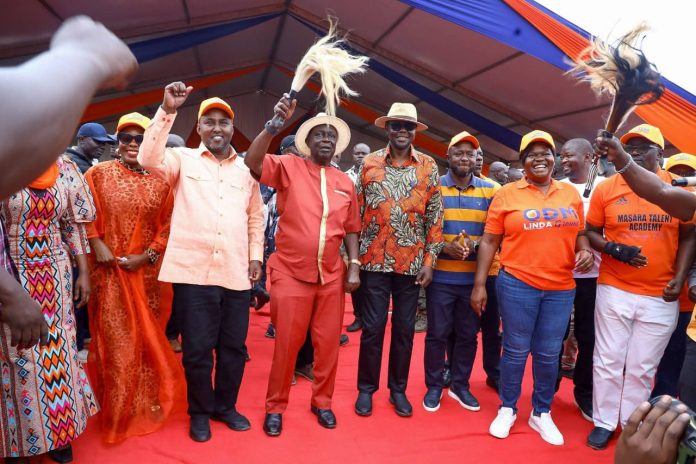
President William Ruto finds himself in a catch-22 situation after his Deputy, Prof. Kithure Kindiki, and Internal Security Permanent Secretary, Dr. Raymond Omollo, recently declared support for ODM candidate for Kasipul Constituency, Boyd Were.

The by-election is a delicate balancing act for Ruto — to either go full throttle and support the ODM candidate and disenfranchise the vote bloc, or sit back, watch, and allow nature to take its course.

At an empowerment funds drive at Sikri in Kasipul, Kindiki and Omollo rallied the electorate to support Boyd as a Broad-Based candidate.

Omollo wrote on his X handle: “Together with Deputy President Kithure Kindiki, we joined the people and regional leadership of Homa Bay County, led by Governor Gladys Wanga, for a resource mobilization and women empowerment drive in Kasipul Constituency.

The meeting also underscored the spirit of the Broad-Based government, as leaders expressed unity of purpose while rallying behind the ODM candidate, Boyd Were, within a framework of inclusivity and national cohesion.”

The move by the Deputy President and Omollo to support the ODM candidate threw the UDA leadership and fraternity under the bus and left them orphaned in the by-election.

The grumpy UDA activist Odoyo Owidi and his team, who had been leading an onslaught on Wanga and Boyd, were left stranded by the unfolding political scenario. They are yet to visit Kasipul to campaign.

Odoyo and the late MP, the slain Charles Ongondo Were, the father of Boyd, the ODM candidate, never saw eye to eye, and the decision by the top government leadership to support Boyd has left them punctured and headless.

Odoyo and Ongondo were both ODM aspirants for Kasipul in the 2022 general elections, but the party issued a direct ticket to Ongondo, which didn’t amuse Odoyo.

President Ruto has made Homa Bay County his second home and brought various development projects to the county. Homa Bay was the bedroom of the ODM leader, the late Raila Odinga.

With Raila’s demise, Ruto hopes to inherit the vote bloc of Homa Bay, but now he has to contend with the emerging political scenario on the ground.

The greater Rachuonyo, which accounts for 40 percent of the votes, is rebelling against Governor Wanga and has rallied behind Deputy Governor Oyugi Magwanga.

Magwanga was forced into a political marriage with Wanga in the 2022 gubernatorial election by Raila, and the two leaders have since fallen out and are now irreconcilable.

Magwanga declined Wanga’s overtures to support Boyd ahead of the ODM primaries and instead advocated for a free and fair nomination.

In the controversial nomination, he supported Kepha Newton Ogada against Wanga’s Boyd, in which the latter won and the former had his vehicles and hospital destroyed by ODM goons.

Ogada recently shared a cryptic photo of independent candidate Philip Aroko which read, “This time it will not be a walk in the park.”

Magwanga enjoys huge support in Homa Bay County, and the decision by the Broad-Based government to ignore his political constituency in the hope that Wanga, the ODM national chairperson, will deliver the county votes may backfire in the 2027 general elections.

Interestingly, Hesborn Omollo, elder brother to the PS, who had engaged in political activities in Homa Bay, was prevailed upon.

Omollo, in a statement on his Facebook page, said his community service engagement should not be misconstrued as an attempt to rally support for a gubernatorial contest.

Omollo’s community engagement had brought disquiet in the ODM wing, with Governor Gladys Wanga and her supporters taking issue with his activities.

Within the last two years, Omollo had crisscrossed the county engaging in fund drives and other activities that created panic among other political players in the county.

“Our journey of engagement has always been rooted in improving the lives of our people. Public service and representation have been at the core of my commitment, dating back to 2007 when I stepped forward to contest for the parliamentary seat of Karachuonyo. Community engagement is not just a duty—it is part of my identity.

Recently, my active involvement in community activities has led to speculation that I intend to vie for the position of Governor. Unfortunately, this has sparked unnecessary tension and unfounded rumors that do not serve our collective progress as a people.

I wish to categorically state that I am not pursuing the gubernatorial seat for Homa Bay County, nor have I stated as such before. This is a time for service delivery, not political competition,” he wrote.

Omollo and Were had differences, with each accusing the other, and often engaged in altercations.

Cabinet Secretary for Treasury and Economic Planning did not attend the empowerment program in Sikri and is yet to campaign for the ODM candidate in Kasipul.

While his counterpart, Opiyo Wandayi, has been campaigning in Ugunja for Moses Okoth to capture the seat, Mbadi has not been seen in Kasipul.

For Ugunja, it may be an easy ride for the Broad-Based candidate, but Kasipul is proving to be a hard nut to crack, as it is viewed as a testing ground for the Wanga–Magwanga 2027 duel.

Ahead of the nomination, Siaya Senator Dr. Oburu Odinga and his sister Wenwa Odinga were said to have supported Ogada against Wanga’s Boyd.

The race is turning out to be a two-horse race between Boyd and Aroko, while other candidates are also showing remarkable command of voters. They include Rateng Kotiende, Robert Riaga, and Collins Okeyo.

Kasipul is a testing ground for President Ruto in his pursuit of Homa Bay votes in the 2027 elections.

We Do Not Need NHIF or SHIF: How Everyone Can Pay for Health

0

By Billy Mijungu

Kenya does not need another bureaucratic insurance scheme to manage healthcare. What we need is a simple, transparent, and fair model that makes every citizen a contributor through everyday consumption, not complicated payroll deductions or mandatory registrations.

Let us introduce a 2 percent Health Levy on consumption collected alongside VAT. This small and affordable rate ensures that everyone, whether formally employed, self-employed, or in the informal sector, contributes to healthcare each time they make a purchase. It would spread the cost fairly and sustainably across the entire population.

The proceeds should be ring fenced and distributed equitably by the Commission on Revenue Allocation (CRA) directly to public hospitals and health centres countrywide. CRA would base allocations on population, need, and performance. Governors would then have strong incentives to build and maintain quality medical facilities to attract higher allocations from CRA, thereby creating healthy competition for better service delivery.

Every citizen with an identification card or with a guardian should be able to walk into any registered medical facility, get treatment, and leave without worry. The government can load registration data for compliant hospitals into the national system for verification. In fact, medical records can be available on the eCitizen portal linked to the Social Health Account (SHA), allowing hospitals to verify patients and claim reimbursement instantly. This will simplify access, promote transparency, and eliminate the long queues and corruption associated with insurance cards and manual verification.

To prevent misuse, the Senate must legislate safeguards to ensure that every shilling sent to medical facilities is spent only on patient care, medicines, equipment, and staff, not diverted to seminars, foreign trips, or non-medical administrative expenses. Funds for policy and administrative activities can remain under county or national ministries, but not touch hospital budgets.

KEMSA must also evolve. Its current role of warehousing and redistributing medical supplies adds unnecessary costs. Suppliers should deliver directly to hospitals while KEMSA focuses on coordination, oversight, and quality assurance, ensuring that facilities receive genuine, affordable, and timely supplies.

We do not need NHIF or SHIF to make universal health access work. We only need integrity, smart fiscal design, and clear legislation that puts hospitals, not bureaucrats, at the centre of healthcare funding.

Malava: The Curtain Raiser for Ruto Against Kalonzo’s United Opposition. Which Way Luhya?

0

By Anderson Ojwang

Eyes are on the Malava Constituency by-election, the curtain raiser for the 2027 presidential election — the fierce race and battle for the 2,217,948 votes.

The curtain raiser pits President William Ruto of the Broad-Based Government against the United Opposition of Kalonzo Musyoka, Rigathi Gachagua, George Natembeya, Dr. Fred Matiangi, among others in the outfit.

Equally, it is billed as the test ground for the Luhya supremacy battle between the Natembeya-led team and the Prime Cabinet Secretary Musalia Mudavadi and Speaker of the National Assembly Moses Wetangula team. Who will call the shots in Luhya land in the 2027 elections?

Malava Constituency offers fodder for the battle for the 2,217,948 Luhya votes, which in successive presidential elections, the majority have voted for the ODM presidential candidate, the late Raila Amolo Odinga.

Interestingly, the immediate former MP, Moses Malulu Injendi, was elected on the Amani Congress Party of Mudavadi, which he later dissolved to join President Ruto’s UDA.

The United Opposition candidate, Seth Panyako of DAP-K, starts as a favorite, having lost the 2022 election to Injendi by only 2,662 votes. Injendi got 22,891 votes to his 20,138.

The exit of Raila from the scene has leveled the playing ground for Ruto against the United Opposition, with the president hoping to build on the 386,456 votes he received in the 2022 presidential elections.

In the last general election, it was only in Bungoma County, the backyard of the Speaker of the National Assembly, Moses Wetangula, where Ruto defeated Raila in the entire Western Kenya. In Bungoma County, Ruto got 255,906 against Raila’s 145,280.

In Vihiga County, the home turf of his Prime Cabinet Secretary Musalia Mudavadi, Ruto managed 67,633 against Raila’s 114,714 votes.

In Kakamega and Busia counties, Ruto secured 141,186 and 48,801 respectively, against Raila’s strong command of 357,187 and 236,042 respectively.

With only 17 days to the by-election, the race is getting murkier, with major realignments, compromises, and betrayals likely to be witnessed.

Yesterday, DAP-K deputy party leader and also Deputy Governor for Kakamega County, Ayub Savula, crossed over and declared his support for UDA candidate David Ndakwa.

The Eugene Wamalwa-led DAP-K party is presenting unionist Seth Panyako in a two-horse race.

Before Savula endorsed the UDA candidate, the UDA Disciplinary Committee had issued summons to Kakamega Senator Bonny Khalwale to explain why disciplinary action should not be taken against him for alleged misconduct and disloyalty.

In a letter signed by the Disciplinary Committee Chairman, Mr. Charles Njenga accused Khalwale of supporting a candidate of a rival party in the by-election.

“Your open support for a rival candidate clearly demonstrates that you are supporting a position against your own party’s interest and acting outside the expected conduct of a UDA member,” read the letter in part.

UDA has now successfully avenged Khalwale’s move by capturing Savula, DAP-K deputy party leader — a game of chess.
Savula said, “Savula ni kupiga hesabu (Savula does calculations). When you see some walking here, the likes of Natembeya, Cleophas Malala, Bonny Khalwale, wanapiga hesabu kwenda nyumbani (their calculations will take them home).

Here in Malava, you supported Malala, he got into the government, why did he disappear to the opposition?
Khalwale contested for governor seat and lost and went back to senatorial. Will you support one term while you have never been in the opposition?”

In a move that was expected to galvanize the opposition vote, Gachagua-led DCP party had withdrawn their candidate, Mr. Edgar Busiega, in support of Panyako, in what they termed a United Opposition agenda to deliver the seat.

Malala said the United Opposition struck a consensus to field one candidate against the UDA candidate in the November by-elections.

Malala said it was important for the opposition to head to the November polls united if they are to clinch the seat.
Malala said: “Na viongozi wetu wote wamekubaliana kwamba hatuwezi kuwa tunajiita United Opposition na kwa kiti ndogo kama ya ubunge, tunapigana wenyewe kwa wenyewe. Tumefanya scientific research, tukapata kwamba ndugu yetu Panyako ako juu kidogo (Our leaders have agreed that we cannot call ourselves United Opposition if we fight over a parliamentary seat. We conducted scientific research that revealed Panyako was leading).”

“By the time I have conceded, it is after I have assessed his abilities and indeed established that I am leaving Malava in safer hands,” said Busiega.

George Natembeya called for unity to deliver victory for Seth Panyako.
“Together, we stand united in our shared vision of a prosperous and empowered region, one conversation, one rally, and one collective voice at a time,” Natembeya said.

Khalwale has been crisscrossing the constituency seeking votes for Panyako and hailed the move by the Democracy for Citizens Party (DCP) to withdraw their candidate from the Malava by-election in favor of DAP-K.

Khalwale described the move by Busiega and his party as standing on the right side of history by joining Panyako’s team, which, according to their internal opinion polls, shows Panyako as the frontrunner among other candidates.

“Congratulations to Team Edgar Busiega for joining the big dream and standing on the right side of history by so graciously stepping down unconditionally for Seth Panyako. The Malava by-election is coming around just fine,” Khalwale said.

Mudavadi, in a bid to avoid being drowned, has expanded his political strategy by enlisting the support of religious leaders and professionals.
Mudavadi, who has been tasked to spearhead the UDA campaigns, has a date with destiny. All eyes are on Mudavadi on whether he can successfully anchor Ruto’s boat to safe landing in Luhya land and deliver the over 2 million votes.
The Malava by-election is the launching pad for the Luhya vote bloc, and it is a must-win for either political divide. For Mudavadi and Natembeya, it is a date with destiny.

Snow takes a commanding lead as Betika Masters heads to the final round

0

By Philip Orwa

Muthaiga Golf Club’s Pro Greg Snow continued with a good outing during the second round of the Betika Masters at Limuru Country Club, extending his lead at the top of the leaderboard to six shots.

The Muthqiga Pro cardes 5-under par for the day to take his overall tournament total to 11-under par, giving himself a strong cushion heading into Tuesday’s final round.

Snow sank in birdies on 1, 2, 3, 6, 10, 11 and 18, with dropped shots on 4 and 13. His solid iron play and disciplined course management kept him in control throughout the day.

“It’s been good. I limited the mistakes and kept giving myself a lot of opportunities for birdies, and I’m taking advantage of that. Got off to a fast start again with three birdies on the first three holes. It’s really been a good ball striking.”

“For tomorrow, the plan is the same. Stick to the process, hit the greens, and create as many chances as possible. The putter is working well, so I just need to stay steady.” Snow Said

Rwanda’s Celestin Nsanzuwera climbed into second place after returning a 2-under par round for a total of 5-under par. His second round included birdies on 3, 13, 15, 16 and 18, a bogey on 8, and a double bogey on 5.
In third place is three-time SDT–EAS winner Njoroge Kibugu, who signed for 3-under par to take his total to 4-under par. His round included birdies on 1, 3, 5, 13, 15 and 18, with a bogey on 2 and a costly double bogey on 17.

Kibugu admitted he struggled to find rhythm off the tee.
“Personally, it wasn’t a very good day for me. I really struggled out there. I didn’t hit my driver well, though the irons gave me chances especially on the par threes. The putts didn’t drop today. I could have finished six or seven under, but that’s golf.”

A three-way tie sits in fourth place, with Jastas Madoya, Dismas Indiza, and Rizwan Charania all ending the day on 3-under par heading into the final round.

The cut was set at 7-over par, with Naom Wafula emerging as the only female golfer to make it into the final round, continuing her strong form on the Tour.

The top 30 players and ties continue tomorrow, where they will be competing for the KSh 2 million prize purse, alongside crucial world ranking points and Safari Tour ranking points that count towards qualification for the 2026 Magical Kenya Open.
A key highlight of the day came from amateur Mercy Nyanchama recorded a hole-in-one on the par-3 14th, marking one of the standout moments of the tournament.

Owalo Inherits Gor Mahia’s Constituency: The Politics of Football, Gains and Losses

0

By Anderson Ojwang

For three decades, the late Raila Amolo Odinga reigned as the patron of the mighty Gor Mahia Football Club.
Raila jealously guarded the post and kept at bay any possible suitor to the throne. For Raila, Gor Mahia was the first and most important center of power.

To ensure his firm grip on the seat was not challenged, Raila’s deputy was the loyal and subservient former Homa Bay Governor, Mr. Cyprian Otieno Awiti.

Raila and Awiti formed a formidable partnership in the management of Gor Mahia and remained at the helm of the club for over 30 years.

Awiti gained popularity by virtue of his position in Gor Mahia, and this contributed to his victory as the first governor of Homa Bay County in 2013 and subsequent election in 2017.

Similarly, Raila drew his political backbone support from his boyhood club, and from the club, he received a near-fanatical following.

With the demise of Raila, a new order has been created with the elevation of Eliud Owalo as the substantive patron of the club.
Owalo, who unsuccessfully contested for the Kibra parliamentary seat and was the campaign manager for Raila Odinga’s presidential campaign in 2013, now finds himself in a new power matrix — the Gor Mahia constituency.

Gor Mahia chairman Ambrose Rachier, in a press release, said Owalo had been appointed as the substantive Gor Mahia patron.

He wrote, “Further to the press release dated 16th October 2015 by the club executive regarding the notification of assumption by the then club deputy patron, Eliud Owalo, as acting club patron, this is to formally notify the general public, the football fraternity in general, the Gor Mahia Football Club members in particular, and the Gor Mahia fans at large, that the club has confirmed the appointment of Mr. Eliud Owalo as the substantive club patron with effect from the first day of November 2025.”

In November 2023, Owalo, then ICT Cabinet Secretary, bought Gor Mahia Football Club a state-of-the-art bus valued at Sh 20 million.
“We would like to express our gratitude to Honorable Eliud Owalo and his associates for making the purchase of the club bus possible. The bus has been customized and has already been registered,” Rachier said then.
Owalo bought the club a new bus after the previous one was auctioned to offset dues owed to former player Wellington Ochieng.

To endear himself to the new constituency, Owalo has embarked on various strategic interventions to make the club viable and financially stable.

Recently, Owalo, through his foundation, donated 35 brand-new tracksuits to the Gor Mahia Youth and 30 tracksuits to the Queens.

Owalo has revealed that the record Kenyan Premier League champions have initiated talks with Kansai Plascon Kenya Limited, formerly known as Sadolin Paints, over a potential sponsorship deal for Gor Mahia Youth and Gor Mahia Queens.
Owalo reiterated his commitment to transforming the club’s financial model into a sustainable business structure.

He wrote on his Facebook page:
“IN PURSUIT OF SPONSORSHIP FOR GOR MAHIA FC
Held an inaugural meeting with the Management of Kansai Plascon Kenya Limited (Formerly Sadolin Paints).
We discussed possible sponsorship for Gor Mahia FC, Gor Mahia Youth FC, and Gor Mahia Queens.
The Plascon team was led by the Managing Director Mr. Kota Enami; Marketing Manager, East Africa, Mr. Kunal Biswas; and HR & Administration Manager Mr. Benard Ogango.
Private sector partnerships anchored on a re-engineered business model are the most feasible avenue for the sustainability of Kenya’s community-based soccer clubs.”

Amayo Ochieng, a Gor Mahia fan, said Owalo has inherited a powerful constituency that, if well utilized, will propel him to greater heights.

“Football and politics go hand in hand. Owalo needs to win the league and the continental cup. He will surely be a legend.

Owalo has good intentions for the team, and his commitment to spend his resources on the team will endear him to the fans,” he said.

Amayo said Owalo has what it takes to fit in Raila’s shoes after Jakom mentored and exposed him to the leadership role of the club.

“Owalo and Rachier’s combination will witness Gor Mahia develop a global business model like those in the professional leagues in Europe and other parts of the world,” he said.